
Corporate Performance-Ready Travel
Corporate travel has a line item for everything.
Flights. Hotels. Ground transportation. Per diem. Conference registration. Client dinners. The entire logistical architecture of moving a leader from point A to point B is accounted for, tracked, and expensed with precision.
What never makes it into the budget—and what costs far more than any of the above—is the toll sustained travel takes on the person running all of it.
The leader who lands exhausted and re-enters a full schedule without a recovery window. The executive who makes three significant decisions on day three of a packed conference because the environment demanded it—and reviews those decisions two weeks later, wondering if they made the right decisions. The high-performer who returns home to their family physically present and directionally absent, running on the last reserves of a capacity that was spent somewhere over the central time zone.
These are not anomalies. They are the predictable, documented outcomes of travel that was planned for logistics and not for the human being executing them.
Performance-Ready Travel Planning is the framework Root & Roam Concierge & Curation uses to close that gap.
This resource page is the full articulation of that framework — what it is, why it matters, how it works, and what it costs when it's absent. Whether you engage RRCC to implement it for your organization or use these principles to audit your own travel demands, this is the place to start.


What Is the Fatigue Gap—and Why It Starts Before You Board
To understand Performance-Ready Travel, you first have to understand what unstructured travel actually does to a leader's capacity.
We call it The Fatigue Gap.
The Fatigue Gap is not a single bad night. It is not jet lag. It is not the tired that resolves with a solid eight hours and a good cup of coffee. The Fatigue Gap is a compounding structural breakdown that activates when sustained travel demand — the accumulation of disrupted sleep, compressed schedules, back-to-back environments, high-stakes interactions, and zero recovery spacing — exceeds the cognitive, physical, and emotional capacity a leader requires to function at the level their role demands.
It builds across days. Not in one moment.
And it does not build equally in every leader. It builds in direct proportion to how much recovery structure is absent from the travel design.
Here is the compound sequence most travel schedules ignore:
Sleep quality degrades not just on the first night in an unfamiliar environment but across every subsequent night—and the degradation compounds. What feels like tolerable rest on night two is measurably less restorative than what the body requires. By night four, the leader is operating on a sleep deficit that no amount of in-flight rest corrects.
The gap between stimulus and response narrows across high-demand travel days until it effectively disappears. The leader stops responding—choosing, considering, and directing and starts reacting. Not because their judgment is poor. Because the cognitive margin that judgment requires has been spent.
Emotional regulation, which demands more internal resource than most leaders account for, thins progressively as physical recovery debt grows. The leader who held composure through a full Monday of client meetings is not the same regulatory system navigating a difficult conversation at 4:30 PM on Wednesday of the same trip. The resource is not the same. The demand is high.
And through all of it, output continues, because the professional standard doesn't adjust when the internal resources do. The leader shows up. The leader performs. The leader delivers. And no one on the receiving end — not the client, not the conference room, not the team back home — sees the structural deficit accumulating behind the performance.
Until it surfaces. Usually in the form of a decision made too fast, a communication sent too short, a relationship that received less than it deserved, or a team that started navigating around their leader without ever being told why.
The Fatigue Gap is not a personal failure. It is a structural one.
And structural problems require structural solutions — not better willpower, stronger coffee, or a rest day bolted onto the end of a trip that's already cost more than it should have.
By Julia Potter On UnSplash
The Three Gaps Performance-Ready Travel Plans Around
Most travel planning addresses the itinerary. Performance-Ready Travel addresses the leader inside the itinerary.
There are three distinct gaps that structured corporate travel creates—and that RRCC's framework is specifically designed to prevent.
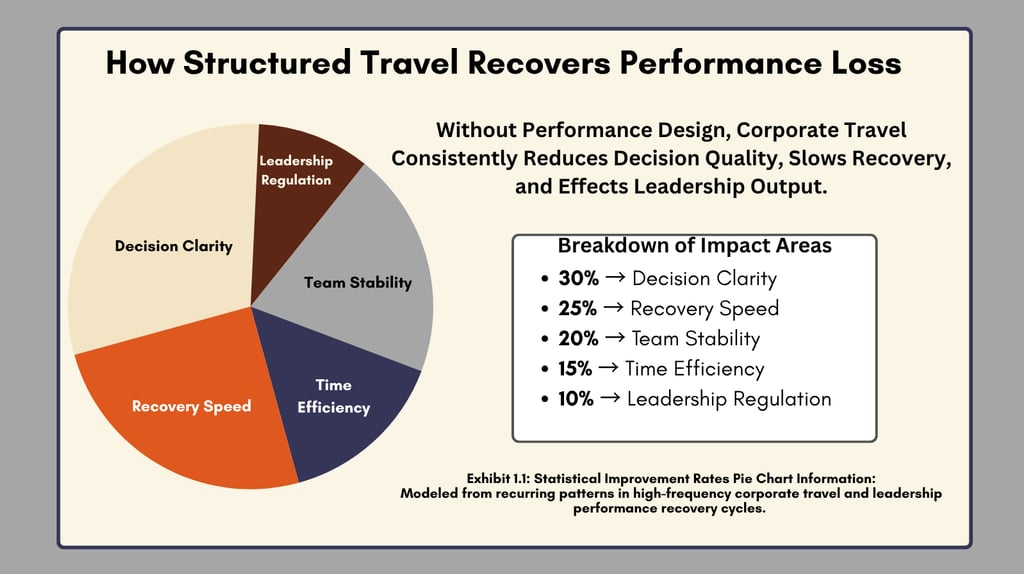
RRCC Resource
The P.A.C.E.™ Method
How RRCC Designs Performance-Ready Travel
Executive Performance-Ready Travel is designed using the P.A.C.E.™ Method:
P — Purposeful Design
Every element supports an outcome — not just completion.
A — Arrival Ease
Time and structure allow for decompression before engagement.
C — Coherence
Schedules and environments support steady communication and presence.
E — Exit Integration
Travel concludes in a way that preserves clarity and continuity.
This method is supported internally by COREOPS™, ensuring consistent execution behind the scenes.


Key Design Principles of Performance-Ready Travel
1. Arrival Is Protected
No high-demand meetings immediately after travel.
2. Schedules Are Intentionally Spaced
Breaks are structured, not optional.
3. Movement Is Minimized
Fewer location changes reduce cognitive strain.
4. Evenings Are Light
Mental processing requires low stimulation.
5. Recovery Is Built In
Performance is sustained through pacing, not effort.
By Vitaly Gariev on UnSplash


Performance-Ready Travel for Corporate Events
For conferences and industry events, performance-ready design ensures:
Clear thinking during high-density schedules
Reduced fatigue across multi-day events
Improved networking quality
Stronger presence in key meetings
See how this integrates with corporate event travel planning
And connects to decision-ready travel strategies
👉 Related:
Explore Corporate Event & Industry Travel
Explore Executive Recovery Travel
Performance-Ready Travel for Executive Relocation
Relocation introduces extended decision-making periods.
Performance-ready design ensures:
Structured transitions
Reduced overwhelm
Continuity across environments
👉 Related:
Explore Executive & Talent Mobility
Explore Strategic Corporate Travel Planning
By Sasun Bughdaryan on UnSplash
Performance-Ready Travel vs Traditional Travel Planning
Traditional Travel Performance-Ready Travel
Schedule-focused Outcome-focused
Dense itineraries Intentional pacing
Reactive Anticipatory
Logistics-first Performance-first
Common Mistakes That Reduce Performance
Overpacked schedules
Immediate post-flight meetings
Constant location changes
Lack of quiet or recovery time
Treating travel days as “available time”
Frequently Integrated Support Services
Depending on the travel context, the following services are often included:
Physical Ease & Comfort
On-site or mobile bodywork providers
Light movement facilitation
Travel Flow & Logistics
Private transportation
Coordinated transfers
Environmental Design
Low-noise accommodations
Strategic location selection
👉 These services are selected based on pacing, environment, and travel goals.
Performance-Ready Travel for Teams & Event Staff
Performance during travel is not limited to leadership.
For corporate teams, exhibitors, and operational staff, travel introduces a different kind of pressure:
Tight schedules across multiple days
Continuous interaction with clients, partners, or attendees
High visibility during presentations, activations, or negotiations
Limited recovery time between responsibilities
Without intentional design, this often leads to:
Reduced coordination
Communication breakdowns
Missed timing or logistical friction
Lower overall team effectiveness
Corporate Performance-Ready Travel ensures that teams are not simply present but able to operate clearly, consistently, and in sync.
This includes:
Coordinated Scheduling
Aligning team timelines to reduce overlap, confusion, and unnecessary urgency.
Managed Movement
Reducing unnecessary transitions between venues, accommodations, and meeting points.
Structured Downtime
Ensuring team members have space to reset between high-demand periods.
Environmental Alignment
Selecting locations and accommodations that support focus, communication, and ease of movement.
These elements become especially critical in corporate event travel planning, where performance is often compressed into short, high-impact windows.
They also support continuity in executive relocation travel support, where teams must operate effectively during extended transitions.


By Oskar Holm on Unsplash


By T.H. Chia on Unsplash
The Future of Strategic Travel
As organizations become more globally distributed, leadership teams increasingly rely on travel to coordinate strategy and collaboration.
At the same time, awareness is growing around the cognitive demands placed on executives who travel frequently.
Future corporate travel strategies are likely to emphasize:
structured travel governance
performance-focused travel planning
leadership retreat environments
executive recovery programs
Within this evolving landscape, Decision-Ready Travel represents a critical component of effective leadership development.
Organizations that intentionally design travel environments to support strategic thinking gain a competitive advantage in decision quality, team alignment, and long-term performance.
Final Thoughts
Travel is often viewed as a logistical challenge to be managed efficiently.
However, when viewed through the lens of leadership performance, travel becomes something much more powerful.
The environments in which leaders meet, reflect, and communicate shape the decisions that define organizations.
Decision-Ready Travel recognizes that where and how leaders travel can influence the clarity, depth, and effectiveness of their decisions.
By designing travel experiences that support cognitive readiness, environmental stability, and strategic dialogue, organizations can transform travel from a routine necessity into a catalyst for better leadership outcomes.
Frequently Asked Questions
What is performance-ready travel?
Travel designed to support clarity, energy, and effective decision-making.
Who benefits most from performance-ready travel?
Executives, leadership teams, and professionals operating under high demand.
How is this different from luxury travel?
Luxury focuses on comfort.
Performance-ready travel focuses on function and clarity.
When should performance-ready travel be used?
Conferences
Relocations
Leadership travel
Multi-day business trips
Related Resource Pages
Decision-Ready Travel
Executive Recovery Travel
Corporate Event & Industry Travel
Strategic Corporate Travel Planning
The Root & Roam Framework for Leaders Who Can't Afford to Land Depleted
You don't lose performance on the road. You lose it in the gaps you didn't plan for.
EXECUTIVE SNAPSHOT
Performance-Ready Travel at a Glance
Most corporate travel is optimized for movement.
Very little is optimized for performance.
RRCC closes the gap between
Where your leaders go
And how they perform when they get there
The Result:
Higher decision quality
Reduced leadership fatigue
Stronger team communication post-travel
Faster recovery + re-entry stabilization
The 3 Gaps We Eliminate
Fatigue Gap → Cognitive decline from unstructured demand
Access Gap → Loss of boundaries due to physical availability
Re-Entry Gap → Poor decisions made post-travel


Calibration Points: Early Signs of Travel-Driven Performance Decline
You return from travel needing recovery before you can think clearly
Decisions made during travel require revisiting afterward
Communication becomes shorter, reactive, or less precise as the trip progresses
Your schedule leaves no space between high-demand engagements
You feel externally “on” but internally depleted
Re-entry feels like catch-up instead of clarity
Root & Roam Concierge Curation
Ready to reduce travel and event pressure?
© 2026. All rights reserved.
Email :
Industry Event Travel Concierge
Corporate Travel strategy
Corporate Travel & Mobility
Resources
Executive & Talent mobility
Company
Connect
Corporate Retreat Planning
Strategic Corporate Travel Planning
Decision-Ready Travel


Live well. move smart. live whole